The Road Not Taken
- Alex G

- 27. Dez. 2025
- 5 Min. Lesezeit
I saved the poem in 2010. I don't remember where I found it. Who recorded it. It's only available as an audio file. I took the liberty of placing the audio file under a picture I created.
Listen to this modern classic; I find Robert's voice particularly moving at the end. Thoughtful, almost melancholic and then, at the very end, almost positive again?
You can find more information about the poem and the author under Robert's lecture.
An analysis, interpretation, and classification of Robert Frost's famous poem “The Road Not Taken” (1916), focusing on its meaning, historical context, and sociological and cultural embedding:
Text Summary
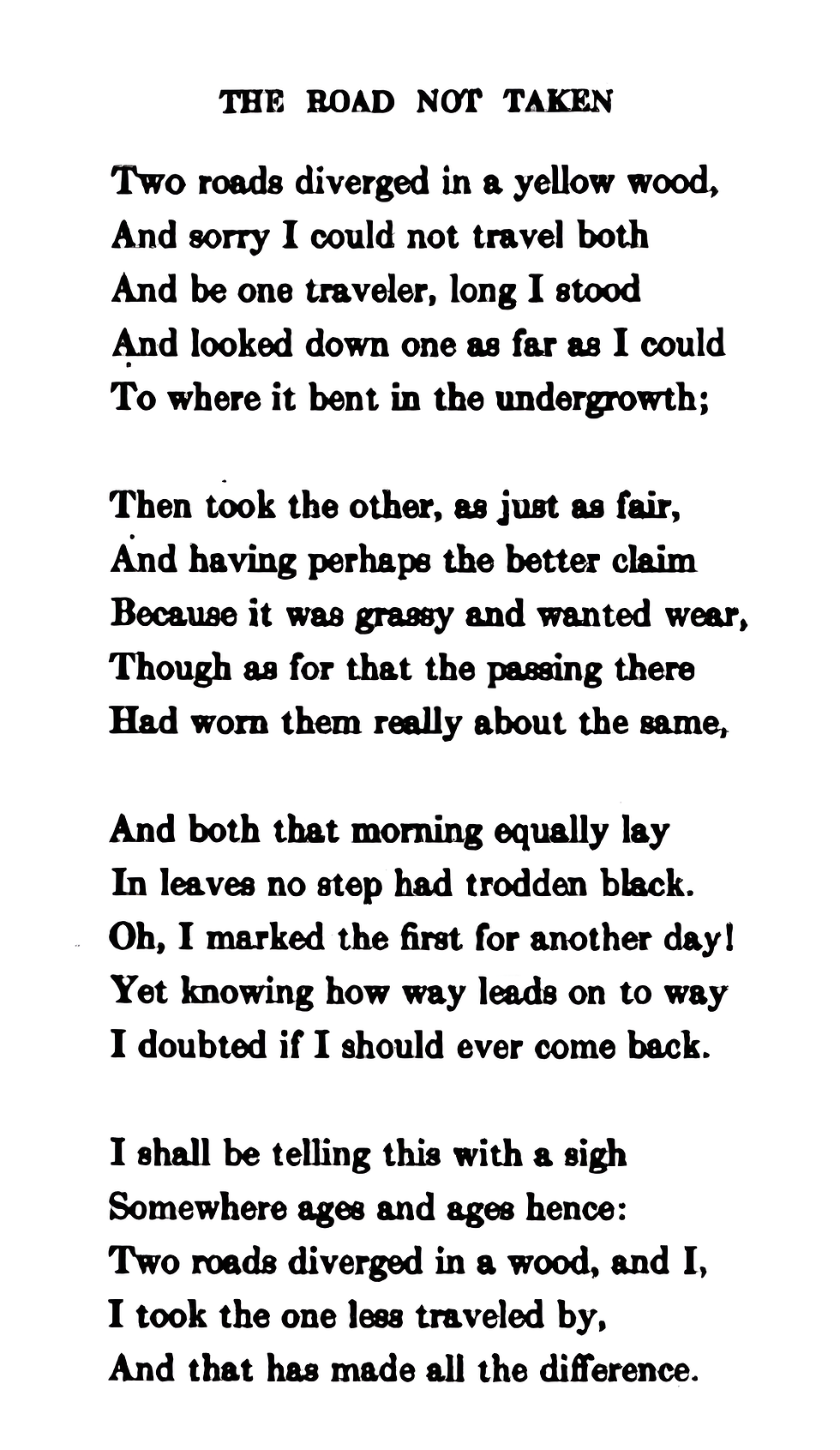
A lyrical narrator stands at a fork in the road in a forest and must decide which path to take. Both paths seem similar, but he chooses “the one less traveled.” In the end, the narrator reflects that this decision “made all the difference.”
At first glance, the poem seems to be a paean to individualism and courageous decisions but Frost deliberately made it ambivalent.
Analysis & Interpretation
1. Theme and Motif
Central themes: Decision, life path, freedom, self-deception, and retrospection.
The “paths” symbolize life decisions that can only be made once.
The speaker emphasizes that he chose “the road less traveled” but before that, he himself says that both roads are actually equally worn.
→ This shows self-interpretation in retrospect: people tend to idealize or rationalize their life path in retrospect.
2. Ambivalence
The poem is not clearly individualistic.
Frost himself said ironically that many readers misunderstand the text as a call for nonconformity.
In truth, it shows the human tendency to search for meaning and self-justification: we tell ourselves stories that our decisions were courageous or “different” in order to give meaning to our lives.
3. Form and language
Four stanzas of five verses, rhyme scheme ABAAB, regular rhythm (iambic tetrameter).
The language is simple but full of metaphors and symbolic density.
“Yellow wood” → autumn, midlife, decision point.
“Sigh” nostalgia”, regret, or contentment remains open.
Historical context
Published in 1916 in the volume Mountain Interval, shortly after the start of World War I.
At that time, the US was torn between isolationism and the decision to enter the war, a social dilemma that reflects Frost's motif of the fork in the road.
Frost lived in England for several years (1912–1915), where he was friends with Edward Thomas, among others.
→ The poem was originally an ironic allusion to Thomas, who constantly regretted not having taken “the other road” on their walks.
Sociological and cultural significance
In American culture, the poem later became a symbol of American individualism and the myth of the self-made man:
“Take the road less traveled” = Be independent, go your own way.
But Frost's actual message is more complex:
He exposes this very myth of self-determination as a retrospective construction.
The poem thus stands between Romanticism (nature, the individual, decision-making) and Modernism (self-reflection, doubt, irony).
Philosophical interpretation
The text touches on existentialist questions. Every person must make decisions without certainty about their consequences. As Sartre later put it, “Man is condemned to freedom.”
Frost shows the loneliness and irreversibility of human decisions, you can never go both ways.
Conclusion
Meaning on the surface: Celebration of individualism (“I chose the other path”).
A deeper level of meaning is: Ironic reflection on self-deception and the construction of meaning in life.
In historical context: the interwar period, uncertainty, pressure to make decisions.
Sociological: a reflection of the American self-image and at the same time a critique of it.
Relevance for today is: Question of authenticity and meaning in a world full of choices
Robert Frost – Life, Work and Significance
1. Biographical Information

Born: March 26, 1874, in San Francisco, California (USA)
Died: January 29, 1963 in Boston, Massachusetts
Full name: Robert Lee Frost
Occupation: Poet, teacher, farmer, lyricist
Era: Modern American Poetry
2. Brief biography
Early years: Frost was born in California. After his father's death (1885), the family moved to Massachusetts on the East Coast. There, Frost developed an early interest in language and nature.
Education: He studied briefly at Dartmouth College and later at Harvard University but dropped out of both.
Family & Career: Frost married Elinor Miriam White, with whom he had six children. He initially worked as a teacher and farmer in New England, a region that influenced many of his poems.
Time in England (1912–1915): He moved to England with his family to pursue his literary career. There he met important poets, including Ezra Pound and Edward Thomas, who helped him publish his first book, A Boy's Will (1913). North of Boston (1914) was also published there and made him famous.
Return to the USA: After his return, Frost became one of the most famous American poets. He won the Pulitzer Prize four times (1924, 1931, 1937, 1943), a record number.
Later years: Frost became a national icon, often referred to as the “poet laureate of New England.” In 1961, he recited one of his poems at the inauguration of President John F. Kennedy.
3. Literary work and style
Themes:
Nature and rural life (many poems are set in New England),
Human decisions and responsibility,
Loneliness, doubt, and the search for meaning, limits of communication,
Relationship between humans and nature.
Stylistic features:
Clear, simple language, everyday language (“plain speech”)
Often traditional forms and rhyme schemes (e.g., sonnet, blank verse)
However, beneath the surface, philosophical and ironically profound
Typical: Everyday scenes with existential meaning
4. Important works
Year Work Significance
1913 A Boy's Will The first book shows Frost's love of nature.
1914 North of Boston Includes “Mending Wall,” “After Apple-Picking,”
among others
1916 Mountain Interval Includes “The Road Not Taken”
1923 New Hampshire Pulitzer Prize; poem “Fire and Ice”
1942 A Witness Tree Later reflections on war and loss
5. Significance and classification
Frost is considered a bridge between tradition and modernity. He used classical forms but dealt with modern themes such as alienation and individual choice. At a time when many poets were writing experimentally and abstractly (e.g., T. S. Eliot, Ezra Pound), Frost remained understandable and down-to-earth without being banal. His poetry is considered typically American: pragmatic, close to nature, self-reflective, and emphasizing freedom.
“The Road Not Taken” became one of the most quoted poems in the world, It is often misunderstood as a call for nonconformity, although it actually shows the ambivalence of human decisions.
6. Quote by Robert Frost
“Poetry is when an emotion has found its thought and the thought has found words.”
(“Poetry is when a feeling finds a thought and the thought finds words.”)
7. Brief summary
Robert Frost was one of the most important poets of the 20th century. He combined images of nature and simple language with profound human questions. His poems, especially “The Road Not Taken” encourage us to reflect on decisions, life paths and self-perception.
This makes Frost a poet of timeless relevance to this day.
References
Online references
Poetry Foundation – Biography and analysis: https://www.poetryfoundation.org/poets/robert-frost
Academy of American Poets – Commentary on works and background information:
Library of Congress – Archive page on Frost's life and work:
Britannica Online Encyclopedia – Article “Robert Frost”:
Primary source
Frost, Robert. “The Road Not Taken.” In: Mountain Interval. Henry Holt and Company, New York, 1916.
Secondary literature & specialist articles
Meyers, Jeffrey. Robert Frost: A Biography. Houghton Mifflin, Boston, 1996.
Thompson, Lawrance. Robert Frost: The Early Years (1874–1915). Holt, Rinehart and Winston, New York, 1966.
Parini, Jay. Robert Frost: A Life. Henry Holt and Company, New York, 1999.
Lathem, Edward Connery (ed.). The Poetry of Robert Frost: Complete and Unabridged. Henry Holt, New York, 1969.
Poirier, Richard. Robert Frost: The Work of Knowing. Oxford University Press, New York, 1977.
Gerber, Philip L. Robert Frost. Twayne Publishers, New York, 1982.
Quellenangaben (seriös & zitierfähig)


Kommentare